

Timber Frame and Modern Design
Heavy timber isn’t a traditional material. It’s a structural one — and when it’s paired with steel, glass, and a contemporary design eye, it produces homes that couldn’t be built any other way.
Contemporary West Coast design has always understood something that takes other markets longer to figure out: natural materials and modern form aren’t opposites. Timber framing gives an architect structural options that light framing can’t offer — longer spans, fewer interior posts, the ability to open a wall to glass without compromising the structure above it. The result is a home that feels open, resolved, and entirely of its landscape. That’s not a rustic aesthetic. That’s a modern one.
Modern Timber
The clients who come to us for modern mountain homes aren’t looking for log cabins. They’re looking for architecture.
Contemporary West Coast design has always understood something that takes other markets longer to figure out: natural materials and modern form aren’t opposites. Timber framing gives an architect structural options that light framing can’t offer — longer spans, fewer interior posts, and the ability to open a wall to glass without compromising the structure above it. The result is a home that feels open, resolved, and entirely of its landscape. That’s not a rustic aesthetic. That’s a modern one.


Structural Choices
The shift from traditional to contemporary in timber framing isn’t cosmetic. It’s structural. Different joinery, different profiles, different relationships between the timber and the other materials it shares a building with.
The most common request we get on contemporary mountain builds is some version of: “I want the mountain to feel like it’s inside.” That means unobstructed glass — and unobstructed glass means the structure above it has to span without landing in the middle of the view. Steel bow-string trusses, moment frames, and engineered timber combinations enable architects to carry heavy loads across long spans. The High Plains Drifter is a good example: custom steel trusses spanning the full width of the living space, no posts interrupting the sightlines, the lake unobstructed from every corner of the room.
Steel + Timber
Steel and Timber Are Better Together
The cleanest contemporary mountain homes are usually the ones where timber and steel are doing the work together — each material doing what it does best, neither one fighting the other. Steel handles tension and long spans. Timber handles compression, warmth, and the visual weight that makes a mountain home feel rooted. When they’re detailed correctly, the combination reads as intentional rather than hybrid. On the Modern Mountain Home in Whistler, we designed a custom steel-timber truss system that met Whistler’s significant snow load requirements while keeping the visual profile clean and contemporary — double rafters, a steel tension chord — a result that doesn’t look like it’s working as hard as it is.


Clean Lines
Heavy Timber Without the Heaviness
Traditional timber framing uses knee braces and angled members to stabilize the frame — which works structurally but reads as rustic. Contemporary timber design solves the same engineering problem differently: mortise-and-tenon joinery cut to tighter tolerances, moment connections at the posts, profiles sized for the actual loads rather than defaulting to the biggest section available. The West Coast Contemporary in North Vancouver — designed with traditional Japanese joinery and deliberately without knee braces — shows what that approach produces: a timber interior that’s clean, elegant, and thoroughly modern without losing any of the warmth that makes heavy timber worth using in the first place.
Our Proven Approach
Glass, steel, and contemporary architecture — built in heavy timber.
Sewell’s Landing — Horseshoe Bay, West Vancouver
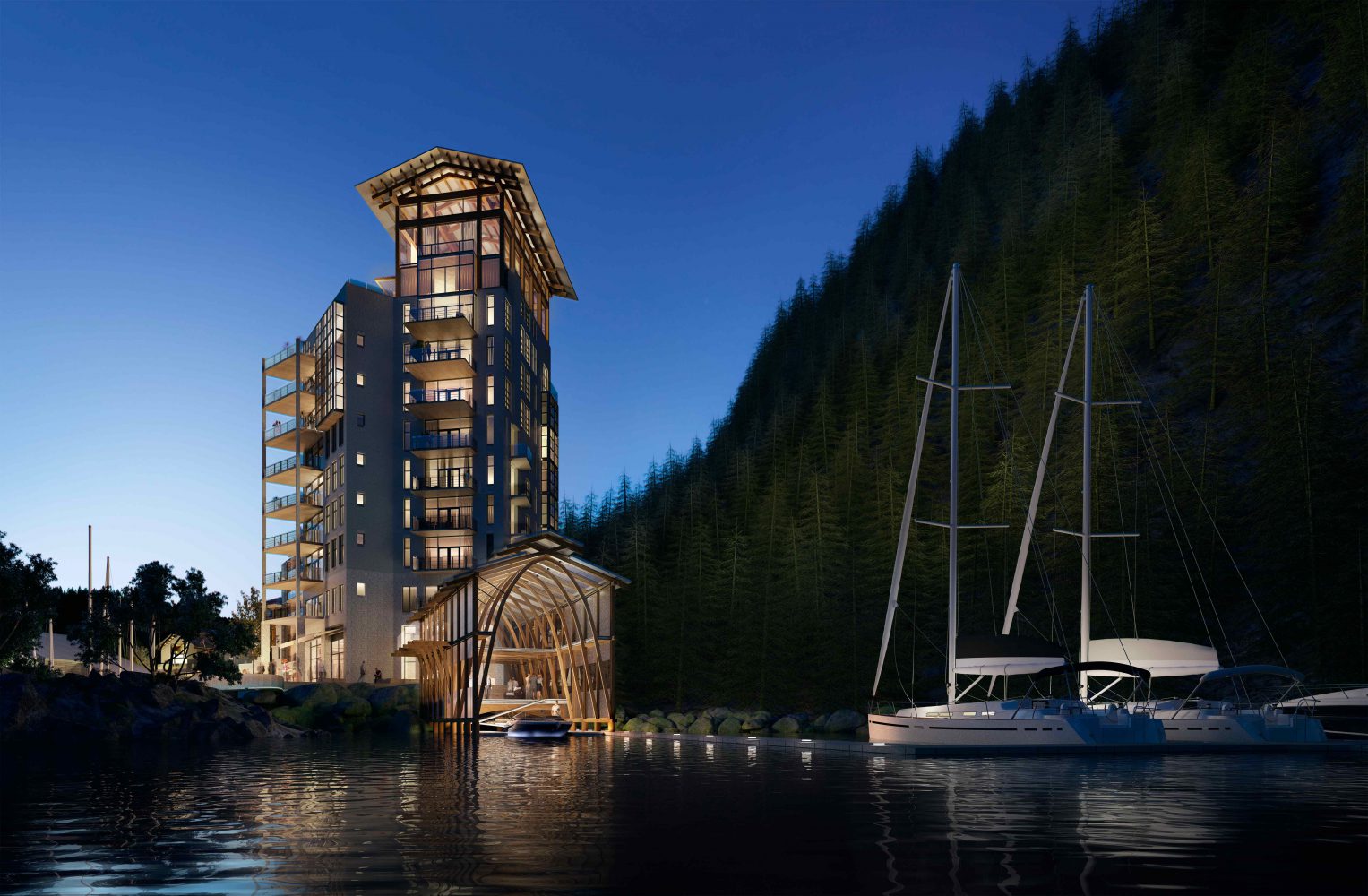
Three and a half million people pass through Horseshoe Bay every year. Sewell’s Landing is what they look up at. Warm timber, structural glass, ocean views — West Coast construction at a scale that earns its place on the waterfront. Building on a commercial project of this visibility, at this location, with those sight lines and that exposure, is a different kind of problem than most fabricators are used to solving. We solved it. The building has been standing on that waterfront, in full marine exposure, ever since.

Breathtaking Bowen Island — Bowen Island, BC (Howe Sound)
The roofline moves in three dimensions, and nothing repeats. No straight lines in plan or elevation. When Grant Architecture Studio brought us this design, we sourced curved steel tubes from a roller coaster manufacturer — because that was the right answer, and finding it required knowing where to look. Every piece was installed using a Leica Total Station and precision laser control. EQ Construction and True Pacific Construction ran the build; Blackcomb Facade Technology handled the glazing on a roofline with no straight lines. West Vancouver clients and their architects ask for things other builders don’t attempt. We attempt them.
Bringing A Timber Frame Vision To Reality — Whistler, BC
A contemporary Whistler home where the exterior detailing, the stairwork, and the relationship between the timbered and non-timbered portions of the building were all resolved as a single design decision. Working with Brigitte Loranger Architecture & Planning and Vision Pacific, the project is an example of what architect-led contemporary timber design looks like when the fabricator can hold the standard the drawings require.

Details That Make a Project Stand Out
We stay in the conversation through design development and coordinate directly with the architectural and structural teams.
Architectural Collaboration
Contemporary Timber Design Requires a Different Kind of Fabricator
Modern mountain architecture tends to involve an architect with strong opinions and detailed drawings. That’s the right starting point. What it requires on the fabrication side is a team that can read those drawings, model the structure in 3D, flag what won’t work before it leaves the shop, and cut to tolerances that a contemporary aesthetic demands.
We’ve worked with Grant Architecture Studio, Murdoch & Company, Brigitte Loranger, and Maureen Berris — firms whose standard is the kind you either meet or don’t. The projects on this page are the result of those collaborations going well. If you’re working with an architect on a contemporary mountain home and you need a fabricator who can match their level, that’s the conversation we’re ready to have.
